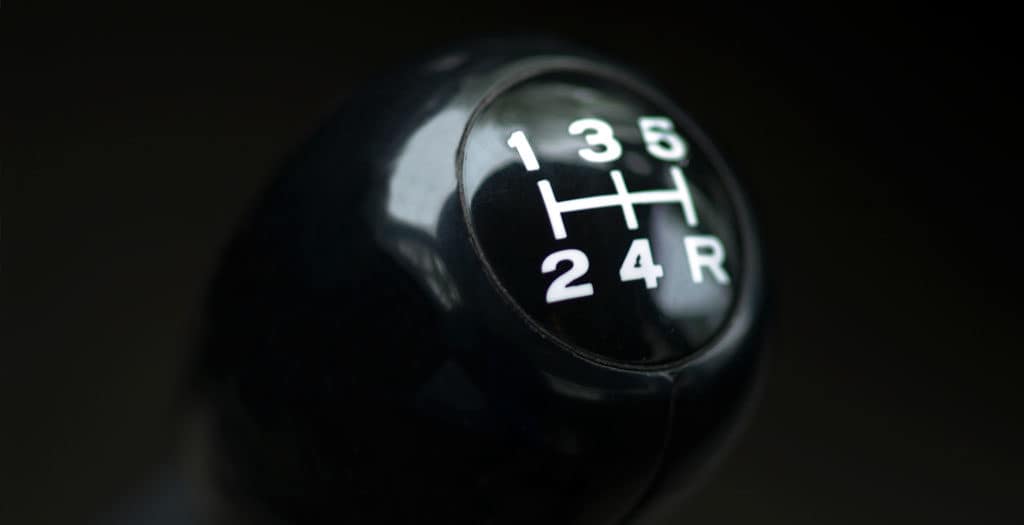
The automotive industry is done with the manual transmission, and it seems it’s at the request of the majority of drivers, as they’ve said they don’t want the manual gear shifter anymore. They didn’t have to come out and say so, as some company has crunched the numbers with a fancy calculator driven by an algorithm that tracks the sale of every car sold. In 2018, only 3.5% of cars sold in the United States required the operator to do the shifting themselves. As it turns out, technology can count high and shift its own gears. Audi, the German car maker, has deliberated and concluded that it’s not worth the work of putting a manual transmission in any of their cars. Since nobody else wants to put the work in to shift, why should they? They say their automatic transmission shifts quicker than the very best manual transmission driver in the world, and that it has a systematized computer that runs the dual-clutch system better than the human driver can do the clutch. It’s man versus machine, and man’s simple faculties can’t shift into second gear quick enough.
The clutch and I have a deep bond. My first vehicle, given to me by my Dad, was a 1987 Chevy S-10 with a 4-speed manual transmission controlling a 150.8 cubic-inch straight-4 piston engine. The engine, one of Chevy’s true masterpieces, nicknamed The Iron Duke, put out approximately 98 horsepower at its zenith, which is plenty to burn rubber, but not enough to win a drag race, since it hardly had more power than a zero-turn lawnmower.
When I turned 15, my dad would take me out east of town and put me in the driver’s seat of the S-10. The truck had this red vinyl bench seat that could cook a steak to well-done in July, and it didn’t even have a cassette player, just a radio that got every country music station from Illinois to Nebraska, but not one single rock station. Imagine my anxiety trying to learn this thing while Tim McGraw serenades me to Indian Outlaw. For a while, I was sure I was going to ride a bike to work my entire life, in true 40-Year-Old Virgin fashion. But I finally figured the thing out, and I’m glad for it. There’s this nostalgic feeling I have about the stick shift, similar to classic vinyl, or renting VHS tapes on a Friday night and ordering a Bigfoot pizza. Shifting a manual transmission reminds me of where I came from, of who I am. That with hard work comes reward, and that things aren’t handed out. It reminds me of the hard work of my mom and dad, and that with an active mind you can do some pretty cool things.
But I understand technology and its advancements. Without it, the things I just named would have never existed. I also wouldn’t be able to binge watch The Office on my drive to work, or order Chicken McNuggets with sweet and sour sauce from my phone. These are challenges I aim to fix in therapy, but until then I want three packs of sweet and sour sauce. To continue on, there’s this beauty to the manual transmission, this basic, essential function of putting in the work to get to where you are going. This manual competence that rewards the driver, that brings him closer to the machine and to life. It’s this primordial individual agency that drives man, requiring one to be an active participant in the advancement of one’s life. I believe in the stick shift, that it is a method of mental stimulation that’s good for the human soul.
I do understand that folks have been fighting the technological system in an effort to preserve nostalgia, all those moments in life that we hold dear. Even though Soundgarden couldn’t be picked up by my AM/FM signal, I do appreciate those times when shifting into second gear coincided with Tim McGraw in his wigwam while beating on his tom-tom. I’ll never forget he’s half Cherokee and Choctaw, and I’ll never forget the joys of the manual transmission. Somewhere there was a man who looked at the 1969 Chevy Chevelle, with its 396-cubic-inch engine and 400 turbo hydra-matic transmission and wished for the peaceful pace of the Model-T, as one might look at the landline and wish to climb a telephone pole to make his call to the operator like on Green Acres. But there was also polio in those days, I don’t think air-conditioning was common, and doctor’s recommended Camel cigarettes.
There is a definitive synthetic quality to the automatic transmission, and I feel this takes away from humans. It pulls us from our natural state of existence – it’s our critical thinking that sits at the core of human advancement, which ironically enough brought us the automatic transmission. Realizing this, one should always find ways to use their mind more. In the words of the great Chinese philosopher Lao Tzu, “The more sharpened tools the people have, the more benighted the state.” Automation separates us from our world, it prevents us from practicing our memory, and it keeps us from shifting into third gear.
P.S. July 19, 2019 – News broke today that Chevrolet’s new C8 Corvette Stingray has ditched the manual transmission for good. The 2020 model will sport an eight-speed dual-clutch transmission that provides “lightning-fast shifts and excellent power transfer” with a thing called an “electronic transmission range selector” that eliminates the mechanical connection between the stick shift and the transmission. This innovation also eliminates a meaningful connection between mind and motor, engine and soul, purpose and pavement. A writer for USA Today states that the dual clutch system in the C8 Corvette is ultimately a manual, and that I don’t need to fumble for the clutch anymore. But I’ve never once fumbled for the clutch a day in my life.
The new Corvette also has a paddle shifter for drivers who want to choose their own gear. So, if you have the brains to work a microwave, you can drive the new manual transmission. But to me, the most robust feeling in the world is taking off in first gear, feeling the motor hit its peak performance, and at the right time, a moment only you and the motor know, you jam the clutch, pull the shifter into second as you punch your elbow into the seat, arms tense, and the tires chirp by your command and your command only. No computer required.
 the snackable